
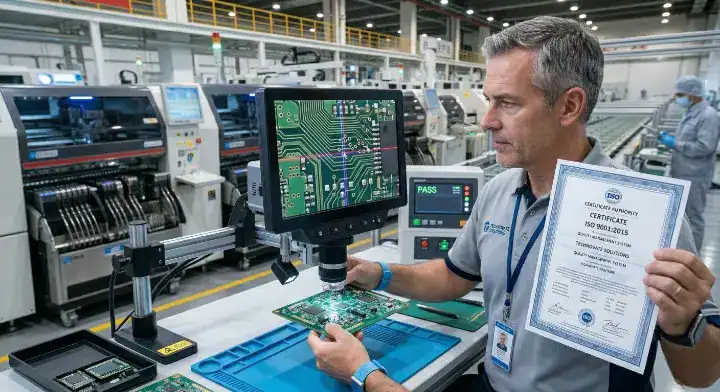
Quick Answer: PCB fabrication certifications should match the board’s market, failure risk, and customer requirements—not a generic logo list. Most commercial sourcing starts with ISO 9001, while UL, RoHS, IPC, ISO 13485, IATF 16949, or AS9100 evidence becomes important only when the product, industry, or customer contract requires it. RoHS currently covers 10 restricted substance groups, so buyers should ask for the right declaration or test evidence instead of treating every compliance document as the same thing.
Key takeaways
- Separate quality-system certificates from product safety recognition, process standards, and material compliance declarations.
- Verify certificate scope, company name, address, expiry date, and registry status before approving a supplier.
- Do not over-specify AS9100, IATF 16949, or ISO 13485 unless the product risk or customer contract justifies it.
- Put certification evidence into the RFQ package so cost, lead time, and inspection plans are reviewed before production.
PCB fabrication certifications matter because they decide whether a supplier can support your product’s quality, compliance, and customer-audit expectations. The problem is that many sourcing pages mix certificates, standards, declarations, and marketing claims into one long list. That makes buyers ask for the wrong paperwork, miss the evidence that actually matters, or pay for controls that do not reduce their project risk.
The safer approach is to start from the board’s intended use. A simple industrial controller, a medical monitoring device, an EV subassembly, and an aerospace communication board do not need the same qualification file. This guide explains how to read the common certification names, where each one fits, and what evidence QueenEMS buyers should request before releasing PCB fabrication.
Table of Contents
- What Do PCB Fabrication Certifications Prove?
- Which Certifications Are Not Really Certifications?
- When Is ISO 9001 Enough for PCB Buyers?
- When Do UL and RoHS Evidence Matter?
- Which Medical, Automotive, and Aerospace Rules Apply?
- How Do IPC Standards Change Acceptance Risk?
- How Should Buyers Verify Supplier Certificates?
- How Do Certification Requirements Affect Cost?
- What Evidence Should Be Included in an RFQ?
- How Should QueenEMS Review Certification Fit?
What Do PCB Fabrication Certifications Prove?
PCB fabrication certifications prove only what their scope says they prove. A quality-management certificate can show that a factory has an audited system for controlling processes, records, corrective action, and customer requirements. It does not automatically prove that your exact PCB stack-up, laminate, solder mask, surface finish, or acceptance class has been qualified for your product.
This distinction matters when comparing suppliers. A certificate can reduce supplier-risk questions, but it is not a substitute for a drawing, stack-up, inspection plan, material declaration, or first article evidence.
The most useful way to classify PCB fabrication evidence is by purpose:
| Evidence type | What it supports | What it does not prove by itself |
|---|---|---|
| Quality-management certificate | Factory system control, audit discipline, corrective action | Your exact board is compliant or defect-free |
| Product or material safety recognition | Safety-related board material or construction evidence | The whole final product is certified |
| IPC standard or class | Fabrication acceptance criteria and workmanship expectations | Supplier has a management-system certificate |
| Restricted-substance declaration | RoHS or similar material compliance claim | Electrical reliability or process capability |
| Customer audit evidence | Fit to a regulated supply chain or buyer program | Universal approval for all customers |
For buyers, the real question is not “Does the supplier have certificates?” It is “Which evidence reduces my release risk?” If ISO 9001 is the baseline, say why. If UL evidence is needed, define the file or marking expected. If IPC Class 3 is required, specify the acceptance class and inspection evidence.
Which Certifications Are Not Really Certifications?
Some items often listed as PCB fabrication certifications are actually standards, declarations, recognition programs, or customer-specific requirements. They can still be important, but calling all of them “certifications” causes poor RFQ wording and supplier confusion.
ISO 9001, ISO 13485, IATF 16949, and AS9100 are quality-management-system frameworks. Their value depends on certificate scope, site address, certification body, and whether the scope covers the work you are buying.
IPC-A-600 and IPC-6012 work differently. They define acceptability and performance expectations for printed boards. A purchase order may require a board to meet an IPC class, but that is not the same as saying the factory has a broad management-system certificate. If your project depends on IPC acceptance, specify class, inspection records, coupons, microsections, and acceptance evidence.
RoHS is also frequently misunderstood. For many buyers, RoHS evidence comes as supplier declarations, material declarations, or test reports. It is a restricted-substance compliance topic, not proof that the PCB will survive thermal cycling or meet impedance tolerance.
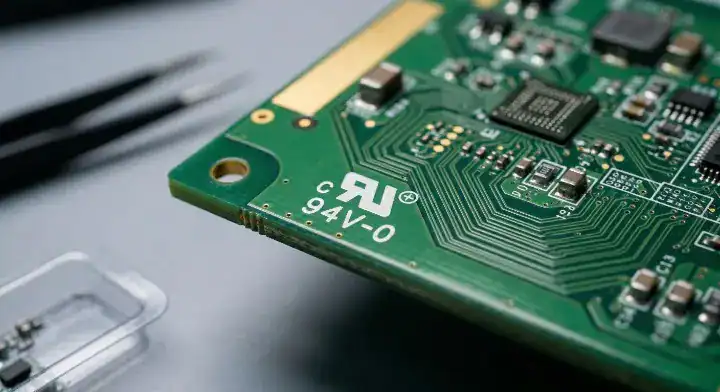
UL has its own nuance. UL recognition may be connected to printed wiring board materials, construction, flammability, or a UL file. It does not automatically mean your finished product has full safety certification. For deeper flammability context, QueenEMS keeps a separate guide to UL 94V-0 circuit boards.
So the first sourcing step is vocabulary control. Write “ISO 9001 certificate,” “UL file or material recognition evidence,” “RoHS declaration,” “IPC Class 2 acceptance,” or “AS9100 supplier scope” instead of asking for every “certification” in one sentence.
When Is ISO 9001 Enough for PCB Buyers?
ISO 9001 is often enough when the PCB is a general commercial or industrial board and the customer does not require a regulated-sector quality system. It gives buyers a baseline check that the supplier has a documented quality-management system, but the certificate still needs to be matched to the production site and scope.
An ISO 9001 certificate points to repeatable controls: document control, corrective action, supplier management, internal audits, and customer requirement handling.
However, ISO 9001 does not answer every engineering question. It does not tell you whether the supplier can hold your controlled impedance tolerance, whether the selected laminate is in stock, whether a via-in-pad process is stable, or whether Class 3 acceptance evidence is available. For those questions, you still need design files, stack-up review, fabrication notes, and inspection records.
Buyers should review four ISO 9001 details before treating it as a qualification gate:
- Legal company name and manufacturing site address
- Certification scope, including whether PCB fabrication is covered
- Certification body and accreditation traceability
- Expiry date, surveillance status, and any exclusions
If the order is low-risk and the board will not enter a regulated or high-liability market, ISO 9001 plus project-specific fabrication evidence may be a practical baseline. If the board must survive tighter electrical, thermal, or field reliability requirements, ISO 9001 is the start of the review, not the finish.
When Do UL and RoHS Evidence Matter?
UL and RoHS evidence matters when product safety, material flammability, market access, customer compliance, or downstream certification depends on it. They should not be requested as generic paperwork; they should be tied to the board material, construction, market, or restricted-substance requirement.
For UL, clarify whether you need board material recognition, a UL file reference, flammability evidence, or support for a finished-product safety evaluation. A bare PCB with UL-related evidence is not the same as a finished product that has passed its own safety certification.
RoHS evidence is different. The EU RoHS framework restricts specified hazardous substances in electrical and electronic equipment, and buyers commonly request declarations or supporting test reports from the supply chain.
The practical RFQ wording should be specific. Instead of “must be certified,” write the target requirement: “Provide RoHS declaration and supporting material evidence on request,” or “Confirm UL-recognized laminate/construction and provide file reference where applicable.” If the board must support a final product safety submission, say that early so the fabricator can check material and construction choices before quoting.
Solder mask, laminate, copper weight, board thickness, surface finish, and special construction choices can affect what evidence is available, so compliance review should happen before quotation is locked.
Which Medical, Automotive, and Aerospace Rules Apply?
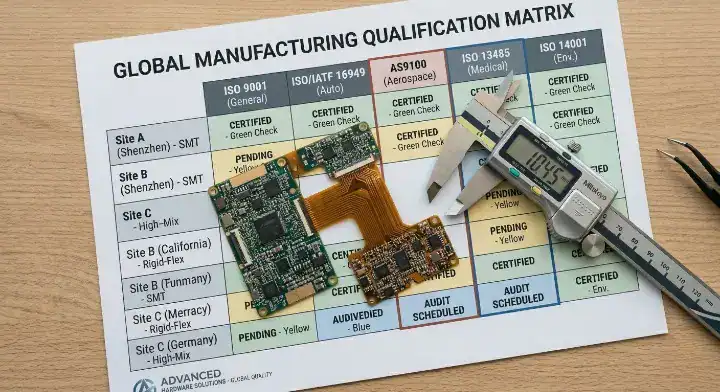
Medical, automotive, and aerospace projects usually need stronger evidence than a normal commercial PCB, but the exact requirement depends on the customer, product role, and contractual flow-down. ISO 13485, IATF 16949, and AS9100 are not universal requirements for every PCB; they become relevant when the supply chain or customer program demands them.
ISO 13485 is associated with quality management for medical devices. For a PCB buyer, the question is whether the board supplier needs that framework, or whether the finished device manufacturer controls suppliers under its own system.
IATF 16949 is used in automotive quality-management contexts and is usually connected to customer-specific requirements. If the PCB is going into an automotive platform, ask what your customer requires and whether the supplier’s scope matches fabrication, assembly, or both.
AS9100, often referenced through IAQG 9100, is used for aviation, space, and defense quality management. It can be important when aerospace customer requirements flow down to PCB suppliers. Buyers should verify the supplier through the appropriate registry and confirm whether the production site and scope match the work.
The safe rule is simple: regulated-sector language belongs in the contract only when it has a source, such as a customer quality manual, compliance matrix, purchase specification, regulatory file, or program requirement.
For medical-device cost and documentation tradeoffs, use the dedicated QueenEMS guide to medical device PCB fabrication cost control instead of expanding this certification article into a full medical sourcing guide.
How Do IPC Standards Change Acceptance Risk?
IPC standards change acceptance risk because they turn vague quality expectations into inspection and performance criteria. For PCB fabrication, IPC-A-600 acceptability language and IPC-6012 performance requirements are often more useful than a supplier’s marketing claim that boards are “high quality.”
The IPC class you specify affects what defects are acceptable, how tightly evidence should be reviewed, and how much inspection burden the supplier may carry. That does not mean every board should be Class 3; the class should match the product consequence of failure.
Connect IPC expectations to physical evidence: coupon data, microsection reports, solderability results, electrical test records, impedance reports, and lot inspection records.
If the project also includes assembly, do not mix fabrication and assembly standards loosely. Fabrication acceptance, assembly workmanship, solder joint inspection, and rework limits belong to different documents and review steps. QueenEMS has a separate guide on how to apply IPC standards for PCB assembly and a decision article on IPC Class 2 vs Class 3 PCB requirements.
The buyer’s goal is to specify an acceptance basis that the supplier can price, build, inspect, and document before the purchase order is released.
How Should Buyers Verify Supplier Certificates?
Buyers should verify certificates by checking the issuing body, official registry where available, certificate scope, production site, expiry date, and consistency with the quoted work. A PDF attached to an email is not enough when the project has compliance or customer-audit exposure.
Start with the certificate itself. Look for the company name, address, certificate number, standard, scope, original issue date, current validity, and certification body. If the certificate covers a parent company, trading company, or different site, ask how that site supports the actual board fabrication process.
Then use the appropriate external check. ISO certificates can often be verified through the certification body’s process. UL evidence should be checked through UL Product iQ. Aerospace quality certificates should be checked through IAQG OASIS where applicable.
Watch for common warning signs:
- Company name does not match the supplier quotation or invoice entity
- Certificate address differs from the production site
- Scope says “trading” or “sales” but not manufacturing or PCB-related work
- Expiry date has passed or surveillance status is unclear
- Certificate image is low resolution, cropped, or missing a certificate number
- Supplier refuses to provide registry or certification-body information
Verification also protects the supplier relationship. If a requirement is applicable, the supplier can include the correct evidence and cost in the quote.
How Do Certification Requirements Affect Cost?
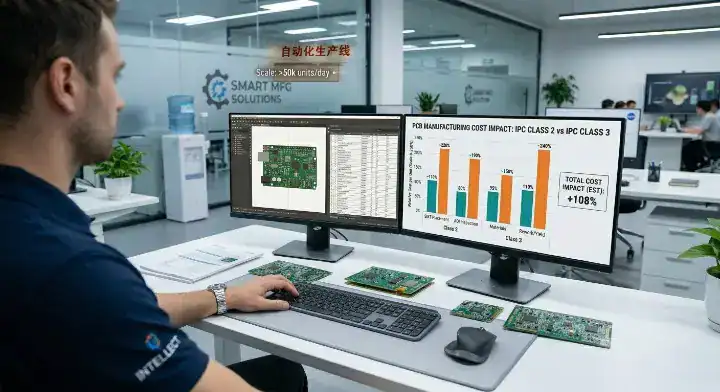
Certification requirements affect cost when they add audits, material constraints, inspection records, documentation control, special process evidence, or lower-yield acceptance criteria. The cost impact is project-specific, so credible sourcing should explain the driver instead of promising a fixed savings percentage.
The most common cost drivers are the controls that come with the requirement. UL-related requirements may limit laminate or solder-mask choices. RoHS documentation may require material declarations. IPC Class 3 may increase inspection and reject risk. Medical or aerospace programs may require stronger traceability and record retention.
Cost also rises when requirements are discovered late. If UL evidence appears after the stack-up is chosen, materials may need to change. If Class 3 appears after a Class 2 quote, inspection and yield assumptions may need repricing.
To control cost, put the requirement in the RFQ and ask the supplier to separate mandatory controls from optional controls. That lets your team compare base fabrication cost, documentation cost, inspection evidence, and lead-time impact. QueenEMS’ guide to PCB fabrication cost drivers can help separate design-driven cost from documentation-driven cost.
The most expensive requirement is often the vague one. A matrix such as “ISO 9001 baseline, RoHS declaration required, UL evidence if safety review requires it, IPC Class 2 acceptance unless otherwise approved” is easier to quote and audit.
What Evidence Should Be Included in an RFQ?
An RFQ should include the certification, standard, compliance, and inspection evidence needed for the board’s real use case. If this evidence is missing, the quote may look cheaper but fail during engineering release, incoming inspection, customer audit, or final product certification.
At minimum, include intended application, target market, IPC class, material requirements, restricted-substance requirements, and any customer-specific quality clauses.
A practical evidence checklist looks like this:
| RFQ item | Why it matters |
|---|---|
| Target market and end-use risk | Tells the supplier whether commercial, medical, automotive, aerospace, or safety evidence may apply |
| Required QMS certificate | Avoids assuming ISO 9001, ISO 13485, IATF 16949, or AS9100 is interchangeable |
| UL or flammability requirement | Connects laminate/construction choices to safety-review evidence |
| RoHS or material declaration need | Sets restricted-substance documentation expectations |
| IPC class and fabrication standard | Defines acceptance criteria and inspection evidence |
| Stack-up, impedance, tolerance, and finish notes | Connects certification review to manufacturability and test risk |
| Required records at shipment | Prevents late disputes over COC, test report, microsection, or lot traceability |
This does not mean every project needs every record. A low-risk prototype may need only baseline quality and material declarations, while a production medical, automotive, or aerospace board may require a heavier release package.
For broader procurement files, connect this certification checklist with the PCB assembly RFQ checklist for engineers and the page on PCB fabrication tolerances worth paying for. The same principle applies: specify the evidence that changes risk, not paperwork for its own sake.
How Should QueenEMS Review Certification Fit?
QueenEMS should review certification fit by matching the buyer’s product risk, market requirement, PCB construction, and requested evidence before release. The goal is not to oversell certificates; it is to make the fabrication and assembly package auditable enough for the customer’s next decision.
For a new inquiry, the review should start with four questions:
- Where will the finished product be sold or used?
- Is the PCB part of a medical, automotive, aerospace, power-safety, or customer-audited product?
- Which certificate, standard, declaration, or shipment record is explicitly required?
- Which requirement changes the material, stack-up, test, inspection, cost, or lead time?
From there, the team can build a requirement matrix: ISO 9001 as the baseline quality-system screen, UL and RoHS against material and market needs, IPC class against acceptance evidence, and regulated-sector requirements only when product risk justifies them.
This review also protects article and site structure. Certification decisions should not replace the deeper engineering pages on UL 94V-0, IPC class selection, fabrication cost, or assembly RFQ files. Instead, this page should help the buyer decide which of those deeper reviews to open next.
If you are preparing a PCB fabrication or PCBA quotation, send the Gerber files, stack-up, drawing, BOM if assembly is included, target IPC class, market/compliance requirements, and any customer quality clauses. QueenEMS can review whether the requested PCB fabrication certifications and shipment records match the product risk before the quote is finalized.
FAQ
Is ISO 9001 enough for a PCB fabrication supplier?
Yes, ISO 9001 can be enough for many commercial and industrial boards when no regulated-sector or customer-specific certificate is required. It still needs to be paired with project-specific evidence such as stack-up review, IPC acceptance class, electrical test, impedance data, or material declarations.
Does every PCB need UL recognition?
No. UL evidence matters when product safety, flammability, material recognition, or a final safety evaluation requires it. The requirement should be confirmed by the product safety plan or certifying lab, not assumed for every commercial PCB.
Is RoHS a PCB certification?
No, RoHS is normally handled through restricted-substance compliance declarations, material documentation, and sometimes test evidence. It does not prove process capability, electrical reliability, or IPC acceptance.
How can I spot a weak supplier certificate?
Check whether the company name, production address, certificate scope, certificate number, issuing body, and expiry date match the quoted work. If the supplier cannot explain registry verification or the scope does not include manufacturing, treat the document as unresolved evidence.
What should I write in my RFQ?
Write the requirement in decision language: required QMS certificate, UL or flammability evidence if applicable, RoHS declaration need, IPC class, and shipment records such as COC, electrical test, impedance report, or microsection data. Avoid asking for “all certifications” without defining why.
Sources
- ISO 9001 quality management systems: https://www.iso.org/standard/62085.html
- ISO 13485 medical devices quality management: https://www.iso.org/standard/59752.html
- ISO 13485 overview: https://www.iso.org/iso-13485-medical-devices.html
- AIAG IATF 16949:2016: https://www.aiag.org/expertise-areas/quality/iatf-16949-2016
- IATF Global Oversight overview: https://www.iatfglobaloversight.org/iatf-169492016/about/
- IAQG 9100 quality management systems: https://iaqg.org/standard/9100-qms-requirements-for-aviation-space-and-defense-organizations/
- IAQG OASIS certification information system: https://iaqg.org/tools/oasis/
- UL Product iQ: https://productiq.ulprospector.com/
- UL PWB sourcing and standardized assembly profiles: https://www.ul.com/news/pwb-sourcing-streamlined-standardized-assembly-profiles
- IPC-A-600 acceptability program: https://www.electronics.org/ipc-600-acceptability-printed-boards-endorsement-program
- EU RoHS harmonised standards: https://single-market-economy.ec.europa.eu/single-market/goods/european-standards/harmonised-standards/restriction-use-certain-hazardous-substances-rohs_en
Written by the QueenEMS Engineering Team
Upload your files today · Free DFM check before production · Ship worldwide
Get your PCB prototypes in as fast as 24 hours. We handle FR4, Rogers, and Flex up to 60 layers — free prototypes for 2–4 layer boards, no minimum order.
Just upload your Gerber + BOM — we source every part, assemble, and inspect (AOI + X‑Ray) so you don't have to chase suppliers. Boards ship in as fast as 24 hours.