
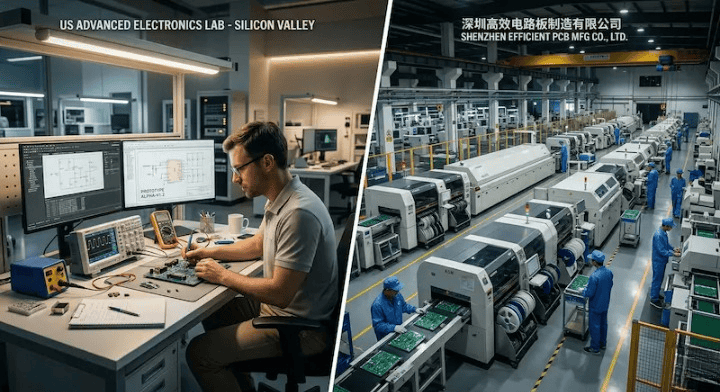
Quick answer: China vs USA PCB assembly is not a simple country ranking. U.S. assembly can fit unstable prototypes, regulated domestic programs, and builds that need same-day engineering access. China assembly can fit cost-sensitive repeat production, turnkey sourcing, mixed assembly, and projects where documentation, test scope, and shipping assumptions are defined before release.
The country decision should begin with the project stage. A board in early bring-up has different needs from a released product with stable files and a known BOM. A buyer who compares only unit price may miss the real drivers: engineering time, component sourcing, inspection evidence, fixture ownership, freight, import handling, and the cost of delays.
Use this page as a sourcing decision framework. The goal is to decide which assembly location fits the current order, what assumptions must be written into the RFQ, and when a hybrid path makes more sense than choosing one country for every build.
Start with the build stage
Prototype, EVT, DVT, pilot, and repeat production orders should not be compared the same way. A prototype may need quick design changes and direct lab feedback. A repeat production build needs stable files, purchasing discipline, predictable inspection, and clean delivery records.
U.S. assembly may be easier when the engineering team expects daily changes, hands-on debugging, or local customer review. China assembly may be stronger when the design is stable enough to benefit from lower labor cost, sourcing support, and integrated PCB fabrication plus assembly. A buyer should state the build stage before asking for a quote.
If the product is still moving from prototype to production, review the QueenEMS article on prototype vs production order switch signals. It helps identify whether the order is ready for a more production-oriented supplier path.
When U.S. PCB assembly may fit better
U.S. assembly may fit better when the design is unstable, the customer needs domestic build control, the project includes sensitive documentation, or the engineering team must inspect and adjust the board in person. Local time zone, shipping speed, and direct lab access can be worth more than a lower offshore unit cost.
Domestic assembly can also be useful for very small builds where freight, customs, and communication overhead would outweigh offshore savings. If the board needs repeated hand modifications, uncertain firmware, or informal engineering experiments, local assembly may reduce coordination friction.
The tradeoff is cost and sourcing flexibility. U.S. assembly may still rely on imported components or bare boards, so the buyer should check the full supply chain rather than assuming “USA assembly” means every input is domestic.
When China PCB assembly may fit better
China PCB assembly may fit better when the files are stable, the BOM can be approved before buying, the quantity is high enough to justify production setup, and the buyer wants PCB fabrication, component sourcing, SMT, mixed assembly, testing, and packing managed together.
The advantage is not only unit price. A capable China supplier can coordinate bare PCB fabrication, stencil, components, line setup, AOI, X-ray, programming, and shipment evidence through one order path. That can reduce handoff cost when the buyer defines the scope clearly.
For supplier screening, compare QueenEMS’ SMT assembly capability, mixed assembly service, and IC programming and testing service. These pages show which assembly operations belong in the quote.
Compare landed cost, not only unit price
Landed cost includes assembly price, PCB cost, component sourcing, fixture cost, inspection, programming, packing, freight, duties, customs handling, payment terms, and the cost of engineering time. A lower assembly price can lose value if the quote excludes work that another supplier includes.
Buyers should compare the same quantity, same BOM revision, same sourcing model, same inspection plan, same test requirement, and same shipping assumption. If one quote is turnkey and another is labor-only, the unit prices are not measuring the same thing.
The QueenEMS guides on comparing PCB assembly quotes and turnkey vs consigned assembly are useful before a buyer decides that one country is cheaper.
Quality evidence should be compared the same way
Quality comparison should focus on the evidence that the order needs. AOI, X-ray, first article review, functional test logs, programming records, rework notes, packing photos, and certificates all carry different value depending on the product. A generic statement that boards are inspected is not enough for a serious comparison.
Ask each supplier what records are included and what must be requested before quote release. If a China supplier includes X-ray and test records while a U.S. supplier quotes only assembly labor, the quality scope differs. The reverse can also happen. Compare the evidence package, not only the location.
For inspection planning, see the QueenEMS articles on first article inspection vs AOI and X-ray inspection for PCB assembly.
Use a hybrid sourcing path when the product matures
Many buyers do not need one permanent answer. A practical path is to build the first unstable prototypes close to engineering, then move pilot or repeat production to a China supplier after the files, BOM, test method, and packing requirements are controlled.
The handoff should be planned. The buyer should transfer the approved Gerbers, BOM, centroid file, assembly drawing, firmware, fixture notes, test limits, approved alternates, and known DFM decisions. Without that record, the second supplier has to rediscover what the first supplier already learned.
QueenEMS can review the release package before the move. The PCB assembly quote file checklist is the right starting point for that transfer.
China vs USA PCB assembly decision table
| Project condition | Often favors U.S. assembly | Often favors China assembly |
|---|---|---|
| Design stability | Frequent engineering changes | Stable released files |
| Volume | Very small urgent builds | Pilot and repeat production |
| Sourcing | Buyer controls most components locally | Supplier manages turnkey sourcing |
| Testing | Lab debug is still changing | Fixture and pass/fail limits are defined |
| Cost focus | Speed and access outweigh price | Landed cost and repeatability matter |
This table is a starting point, not a rule. A buyer should still request written assumptions from each supplier because the real decision depends on the specific board, BOM, inspection scope, and delivery requirement.
Do not ignore freight, customs, and payment timing
Freight and customs can change the result of a China vs USA PCB assembly comparison. A China quote may look lower at the factory gate, but the buyer should add freight method, customs handling, duties where applicable, insurance, payment fees, and the time value of international transit. For urgent prototypes, the shipping clock can matter more than the assembly price.
Payment timing also affects cash flow. Component-heavy turnkey PCBA may require purchasing parts before assembly starts, and expensive or NCNR components can change the deposit requirement. Ask when the supplier buys parts, when the buyer must approve substitutions, and what happens if the schedule changes after materials are purchased.
For international orders, keep Incoterms and delivery responsibility written in the quote. A DAP, DDP, or EXW assumption can move cost and risk from one side to the other. The country comparison is not finished until logistics terms are part of the same quote table.
Communication rhythm can decide the real lead time
Lead time is not only machine time. It includes how quickly DFM questions are answered, how fast BOM substitutions are approved, how clearly test failures are reported, and whether the supplier can separate engineering issues from commercial issues. A one-day delay on every question can erase the price advantage of a lower quote.
Before choosing the supplier, agree on the communication path. Name the buyer-side owner for engineering approvals, sourcing approvals, quality disposition, and shipment documents. Ask the supplier to keep open questions in a written list so the order does not depend on chat history alone.
This is especially useful when a U.S. engineering team works with a China production team. The time-zone gap is manageable when questions are complete and decisions are documented. It becomes expensive when every answer creates a new unclear question.
FAQ about China vs USA PCB assembly
Is China PCB assembly always cheaper?
No. China assembly often reduces labor and sourcing cost, but the final answer depends on quantity, freight, inspection, fixture work, component availability, and how stable the release package is.
Is U.S. PCB assembly always safer?
No. Local access can help unstable builds, but quality still depends on process control, component approval, inspection evidence, and test records. A domestic supplier with weak documentation can be riskier than an offshore supplier with strong controls.
Can I prototype in the U.S. and build production in China?
Yes. That hybrid path often works when the prototype record is transferred cleanly. Keep final Gerbers, BOM, centroid data, test limits, approved changes, and known build notes together before moving the project into controlled production.
What should I send QueenEMS for comparison?
Send Gerber or ODB++ data, BOM, centroid file, assembly drawing, quantity, target delivery date, sourcing model, test scope, and any customer evidence requirements. QueenEMS can review whether the project is ready for China PCBA production and what assumptions should be quoted.
Written by the QueenEMS Engineering Team
Upload your files today · Free DFM check before production · Ship worldwide
Get your PCB prototypes in as fast as 24 hours. We handle FR4, Rogers, and Flex up to 60 layers — free prototypes for 2–4 layer boards, no minimum order.
Just upload your Gerber + BOM — we source every part, assemble, and inspect (AOI + X‑Ray) so you don't have to chase suppliers. Boards ship in as fast as 24 hours.